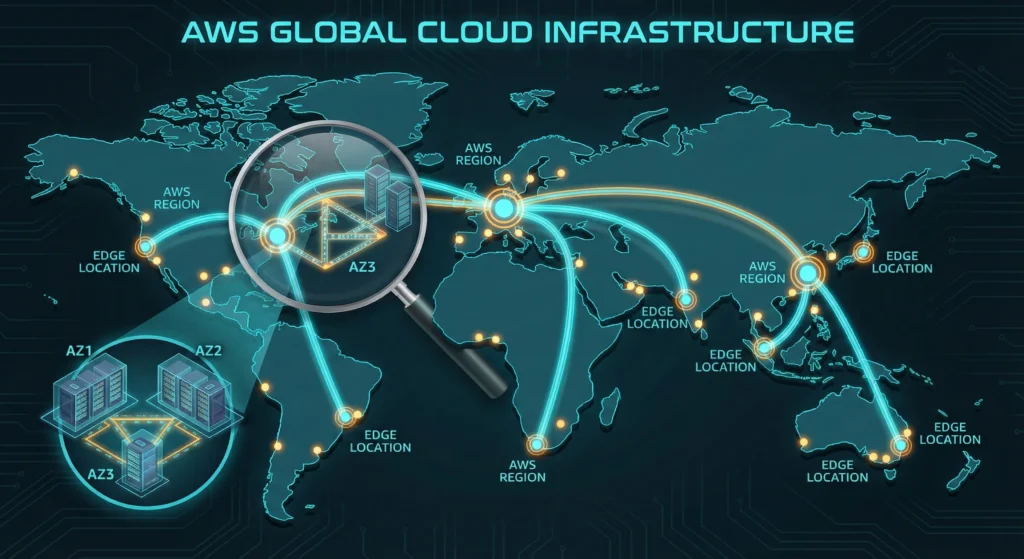
AWS Global Cloud Infrastructure: Regions, AZs, and Edge Locations
Think as: A Massive International Pizza Chain (e.g., Domino’s)
Imagine AWS is the world’s biggest pizza delivery company. To serve fresh pizza (data) to everyone, everywhere, they need a smart structure:
- AWS Region = The Central Kitchens in a Big City: Think of a Region as a major city (like Mumbai or London). In this city, the company has set up its main operations. They don’t just have one kitchen; they have a few scattered around the city.
- Availability Zone (AZ) = The Individual Branch Kitchens: Inside that city (Region), there are specific branch kitchens located a few kilometers apart. If the kitchen in “Area A” catches fire or loses power, the kitchen in “Area B” (10 km away) instantly takes over the orders. This ensures the business never stops.
- Simple Logic: One Region (City) has multiple AZs (Kitchens).
- Data Center = The Ovens and Fridges: Inside every Branch Kitchen (AZ), there are actual physical rooms filled with ovens and fridges. In AWS terms, these are the buildings filled with servers and cables.
- Edge Location = The Delivery Bikes/Scooters: These are everywhere! Even in small towns where there is no big kitchen. The delivery bikes carry pre-made popular items (like Coke or Garlic Bread) so they can hand them to the customer instantly without going back to the main city kitchen. This makes delivery super fast (Low Latency).
Understand how AWS keeps the internet running without crashing.
The AWS Global Cloud Infrastructure is the physical hardware and network that runs the cloud. It is designed so that if one part breaks, the rest keeps working (Fault Tolerance).
Key Components Breakdown:
- Data Centers:
- A highly secure physical building full of servers (computers), storage, and networking gear.
- Security: These places are like fortresses. High walls, guards, and biometric scanners.
- Redundancy: They have backup power generators and cooling systems.
- Availability Zones (AZs):
- One or more discrete data centers with redundant power, networking, and connectivity.
- Distance: They are usually separated by up to 100 km (60 miles). This is far enough so a flood in one doesn’t affect the other, but close enough to send data between them instantly.
- Why use them? If you put your website in just one building, and that building loses power, your site dies. If you put your website in 2 AZs, your site stays alive even if one building goes dark.
- Regions:
- Physical location in the world where AWS clusters its Availability Zones.
- Examples:
us-east-1(Virginia),ap-south-1(Mumbai),eu-west-1(Ireland). - Count: Currently, there are roughly 38 Regions and 120+ Availability Zones (these numbers grow constantly).
- Data Sovereignty: This is a fancy term meaning “Data Laws.” If the Indian government says Indian banking data must stay in India, you select the Mumbai or Hyderabad Region.
- Edge Networks (Points of Presence – PoP):
- Definition: A global network of small servers located very close to users (in major cities globally).
- Function: They act as a Content Delivery Network (CDN).
- Example: If you are in Bangalore watching a Netflix show hosted in the USA, the video doesn’t travel from the USA every second. It is “cached” (stored temporarily) at an Edge Location in Bangalore, so it loads instantly without buffering.
DevSecOps Architect” Level
Designing Highly Available (HA) and Disaster Tolerant architectures using Global Infrastructure.
As an Architect, you don’t just “use” regions; you design strategies around them for Resilience and Compliance.
- Multi-AZ Architecture (High Availability):
- Strategy: Always deploy applications across at least two AZs within a Region.
- Load Balancing: Use an Application Load Balancer (ALB) to distribute traffic. If an EC2 instance in AZ-1 fails health checks, the ALB routes traffic to AZ-2.
- Data Consistency: Synchronous replication happens within a Region (e.g., RDS Multi-AZ). This ensures
RPO(Recovery Point Objective) is near zero.
- Multi-Region Architecture (Disaster Recovery & Business Continuity):
- Strategy: Used for mission-critical apps (Banking, Healthcare).
- Replication: Use Cross-Region Replication (CRR) for S3 buckets or Global Tables for DynamoDB.
- Latency-Based Routing: Use Amazon Route 53 to direct user traffic to the Region physically closest to them to reduce latency.
- Active-Active vs. Active-Passive:
- Active-Passive: The secondary region is on “standby” (cheaper, higher RTO).
- Active-Active: Both regions serve traffic (expensive, zero downtime).
- Edge Computing & Hybrid Cloud:
- CloudFront: The CDN service that utilizes the 700+ PoPs to cache static content (images, css, js).
- Global Accelerator: Uses the AWS global network backbone (instead of the public internet) to route user traffic from the Edge to the nearest Region, reducing packet loss and jitter.
- AWS Outposts / Local Zones: Extending AWS infrastructure to on-premise data centers or specific metro areas for single-digit millisecond latency (5G applications).
- Amazon CloudFront: For content delivery via Edge Locations.
- Amazon Route 53: For DNS and traffic routing.
- AWS Global Accelerator: For network performance.
Use Case: The “Big Billion Day” Sale
Scenario: An Indian e-commerce giant (like Flipkart or Amazon India) is running a massive sale.
- The Challenge: Millions of users log in at 12:00 PM. If the server crashes, they lose crores of rupees.
- The Solution (Using Global Infra):
- Region: They host the main application in the Mumbai Region.
- Availability Zones: They run servers in AZ-1, AZ-2, and AZ-3. If the power grid fails in South Mumbai (AZ-1), traffic automatically shifts to North Mumbai (AZ-2).
- Edge Locations: Product images (shoes, phones) are cached in CloudFront Edge Locations in Delhi, Chennai, Kolkata, and Bangalore. A user in Chennai downloads the image from the Chennai Edge location, not the Mumbai server.
- Result: The site loads fast, and never crashes.
Benefits
- Low Latency: Speed is money. Faster loading = more sales.
- Fault Tolerance: Hardware failure is inevitable; the system handles it automatically.
- Compliance: Customer credit card data stays within Indian borders (Data Residency).
—
Technical Challenges
- Data Sovereignty Laws: You cannot just copy data anywhere. GDPR (Europe) or RBI guidelines (India) strictly prohibit moving PII (Personally Identifiable Information) outside the country. You must configure permissions carefully.
- Cost of Replication: Transferring data between Regions (Inter-Region Data Transfer) costs money. Having a duplicate environment in a second region doubles your infrastructure bill.
- Replication Lag: While AZ-to-AZ replication is synchronous (instant), Region-to-Region is usually asynchronous. In a disaster, you might lose the last few seconds of data.
—
Cheat Sheet
| Feature | Scope | Analogy | Key Function |
| Region | Geographic Area (Country/State) | The Main City (HQ) | Data Sovereignty, Hosting Location. |
| Availability Zone (AZ) | Cluster of Data Centers | Branch Offices in the City | High Availability (HA), Fault Tolerance. |
| Data Center | Physical Building | The Engine Room | Holds the actual hardware (Servers). |
| Edge Location (PoP) | Global City Points | Delivery Boys/Kiosks | Low Latency, Caching content (CDN). |
| Local Zones | Specific Metro Area | Pop-up Store | Ultra-low latency for specific cities. |